

Beneath the Ice
The text is never fixed

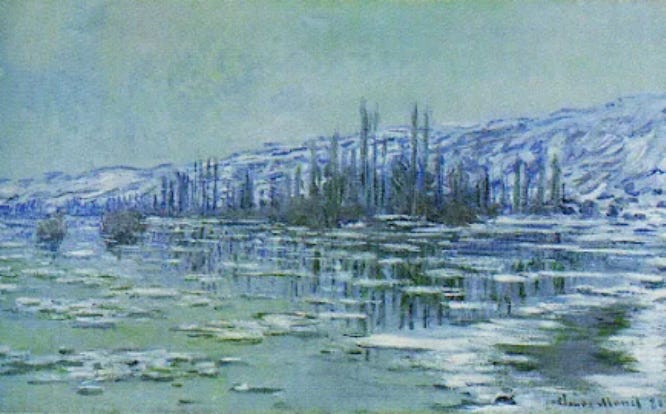
I want you to think of the book on your nightstand right now as a river, frozen in the night. You can read everything on the surface of the river. That means all the craft which were yesterday busily plying the river, which have now come to a halt, frozen in place. It means fallen branches and other riverside detritus, partly submerged in the ice. Most important it means the general shape of the river, sinuous and taut at the same time, easily followed and anticipated, at least until the river bends out of sight.
Perhaps you can spot adventurers on the ice, those familiar enough with its depth to risk ice-fishing or skating along, carving out their initials with the blades of their skates. They’re critics, reviewers, teachers. It's not a sport for everyone, but watching them explore can help you understand the river better.
There are invisible currents carrying the story downstream. Even the author may not be aware of them. The river’s speed and direction are shaped by its slope, by obstructions along its path, by the temperature of the writer’s thoughts.
You also see something peculiar to you, which is your own reflection, your surroundings, your sky, yourself. You are part of the river, a vital part. You bring your stance, your angle, your history, without which the river is not complete.
Here's what you rarely glimpse, though, unless you happen to be a writer, versed in a special way of seeing the river of the book. What we see is the the river beneath the ice, still alive, still flowing, still breathing, still teeming with all the aquatic life, slowed down, but active. We see words not chosen, passages scrubbed, streams converging and parting, pacing rising and falling.
We can't see them crystal-clear, of course, but we are always conscious of the book as a living, ever-changing, ever-busy thing, and we understand how mud or sand or rock in the river-bed fashions the entire river, how the entire-eco-system blends into a seamless, flowing channel. We’ve felt the rain on our faces and glimpsed the ocean of story.
Take Leaves of Grass, for instance. The first edition, (self-)published in 1855, was only twelve poems. The last iteration, published just before Whitman’s death in 1892, was almost four hundred poems. It was continually revised over nine editions.
I celebrate myself;
And what I assume you shall assume;
For every atom belonging to me, as good belongs to you.
I loafe and invite my Soul;
I lean and loafe at my ease, observing a spear of summer grass.
Houses and rooms are full of perfumes—the shelves are crowded with perfumes;
I breathe the fragrance myself, and know it and like it;
The distillation would intoxicate me also, but I shall not let it.
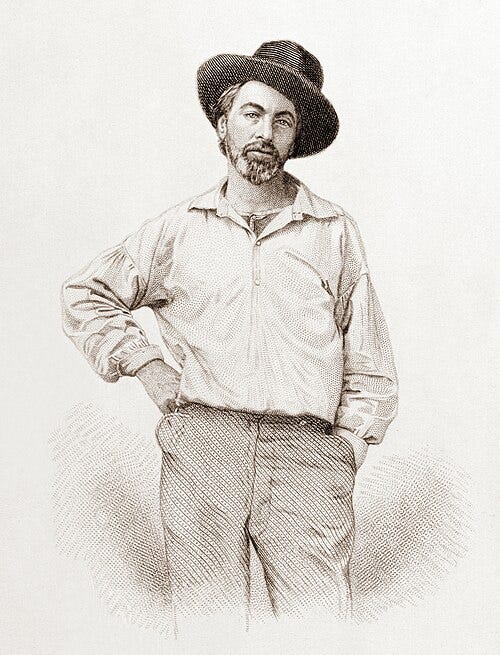
[Thus begins the first, untitled poem in 1855. In 1892, that poem, Song of Myself, begins the same:]
I celebrate myself, and sing myself,
And what I assume you shall assume,
For every atom belonging to me as good belongs to you.
I loafe and invite my soul,
I lean and loafe at my ease observing a spear of summer grass.
[But now the river’s been expanded, diverted:]
My tongue, every atom of my blood, form’d from this soil, this air,
Born here of parents born here from parents the same, and their parents the same,
I, now thirty-seven years old in perfect health begin,
Hoping to cease not till death.
Creeds and schools in abeyance,
Retiring back a while sufficed at what they are, but never forgotten,
I harbor for good or bad, I permit to speak at every hazard,
Nature without check with original energy.
[—before it returns to the same stream:]
Houses and rooms are full of perfumes, the shelves are crowded with perfumes,
I breathe the fragrance myself and know it and like it,
The distillation would intoxicate me also, but I shall not let it.
This is especially true today with ebooks, which can be re-edited even after they’ve been released.
Of course, the publishing career of Leaves of Grass is an exception, but not an exceptional exception. Everyone is familiar with revisions and updates of classroom textbooks. New editions of non-fiction books, especially in the areas of science, are common. What about novels?
There’s The Exorcist. For its 40th birthday edition, William Blatty jumped at the chance for a new polish. Tolkien rewrote The Hobbit after publishing The Lord of the Rings, especially the all-important “Riddles in the Dark” chapter that links the two works. Frankenstein underwent heavy revision between the first, anonymous printing, and the one five years later, which Shelley had printed under her own name.
Then there’s Trimalchio—the final proofs were sent to the author before publishing, but he decided to revise, and revise, and revise, before it was finally published—under the title The Great Gatsby.
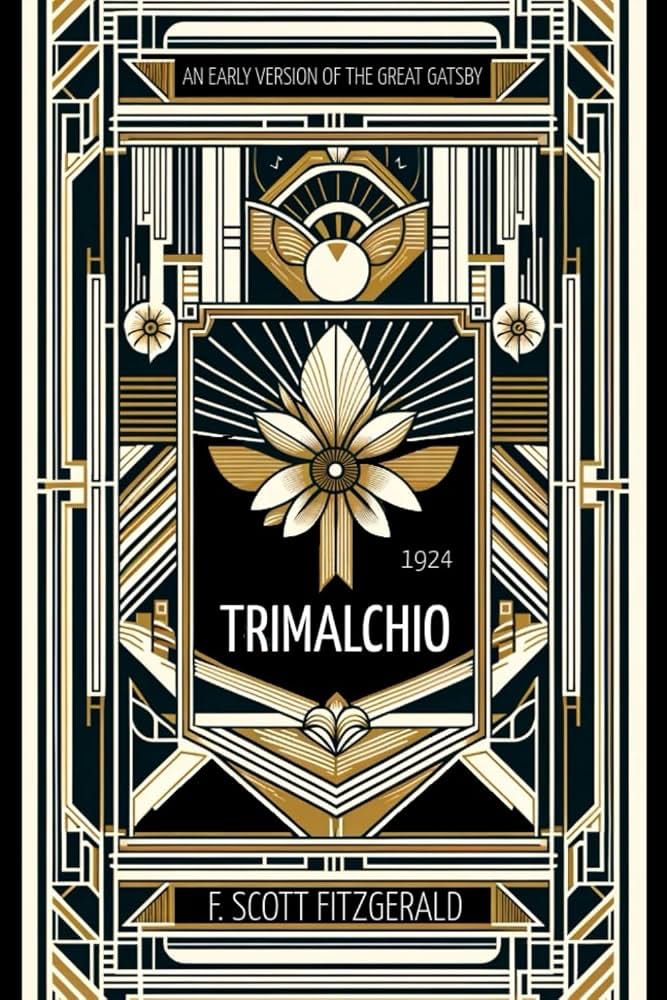
.George Eliot, Henry James, Arthur C. Clarke, even Stephen King are in the roll of authors who have re-jiggered their works after first editions.
And with the advent of e-books, and especially as novels move toward e-book-only publication or print on demand, the process has becomes streamlined. Here’s Amazon’s instructions for updating your e-books:
Go to Manage Your Content and Devices.
Search for your Kindle book.
If available, select Update Available, then select Update.
Easy peasy. So how many self-published authors are out there, re-writing their books every time they get a Wilde itch to change a comma, get a sudden idea that changes a Trimalchio into a Gatsby, get a complaint from a reader that there are too many instances of the word “fuck” in their books? Amazon doesn’t keep records, but you know it’s happening.
Will books of the future always be works in progress, only finding their final form when the author is on their deathbed?
Will they become a compromise or a collaboration between author and reader?
Or a launch pad to the author’s other books, directing the reader to their references, their inspirations?
Aren’t they already? Haven’t they always been? We’re just seeing a compression of the process.
For the writer, a book is never a finished thing, it's always wriggling in the hand, like a fish we’ve just hooked. Is it big enough, or should we throw it back, hoping the day will come, maybe next summer, when we can lure it again from the depths and complete that latest draft?
Because the text is never finished, you will see the same themes and tropes resurface throughout a writer’s work, as they come back year after year to the same river, waiting and watching for the ice to crack with spring thaw.
Is this vision of the river accessible only to writers and critics? No, but it’s not for the casual reader, the speeder, the skimmer. It’s only for the slow reader, the re-reader, the word-appraiser.
But one thing I'd like you all to keep in mind: the book is ALIVE.