

Character as Algorithm
Let the wookiee win.

If you’re a writer, you’re familiar with this phenomenon: a character takes on a life of their own, dictating to you what they will and won’t say, will and won’t do. What the hell? you say. I brought you into this world, and I can take you out of it.
Well, yes—but that’s about your only choice when a character gets uppity and strikes out on their own. Kill off the character, or delete them. You cannot discipline them. If you rewrite them, you rewrite them from the ground up. They are essentially a new character. Only the name has not been changed to protect the writer.
Why is that? Why can’t you do whatever you want with a character? Why can’t you put a clown nose on Prince Hamlet if you want to? (Stoppard came close, with Rosencrantz and Guildenstern, but those were only cardboard characters stood up for plot’s sake before Tom got a hold of them.)
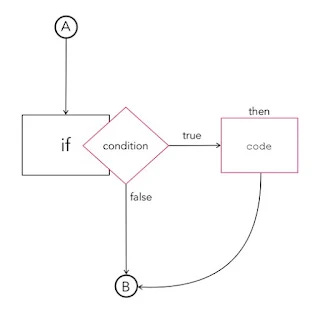
Because a character is essentially a set of rules you’ve created. An algorithm, to use a despised word. A series of nested “if…then” statements that guide the character’s actions. Each step further through the algorithm shrinks your field of play, defining, limiting your options. If your story starts as a multiverse, each choice prunes a possible timeline.
Take my old friend Sherlock Holmes, for instance. Here is rule number one of the Holmesian canon: Holmes solves puzzles—like nobody’s business.
Corollary: he solves them with his mind, not his fists. (This is indeed the wall between Holmes and hard-boiled detectives like Philip Marlowe, whose number one directive as outlined by his creator, Raymond Chandler is “when in doubt, have somebody pull a gun.”)
This is not to say that Holmes never gets physical, never carries a gun. We all know that he’s lethal at single stick and baritsu. But in the canon, fisticuffs rarely come into play. It’s significant that the only person killed at Holmes’s hands is Moriarty.
So when we see a pastiche like Guy Ritchie’s Young Sherlock series, the question is “Yes, it may be entertaining, but is it Holmes?” And we judge it not by whether a budding Sherlock sprouts a whole family (including a slim, trim, thick-headed brother Mycroft), or adopts Moriarty as his (far more charismatic) sidekick, but “Is this a story about solving puzzles with his mind or his fists?” And since Guy Ritchie is a master at throwing the kitchen sink at action scenes but woefully deficient at understatement, most Holmes purists are inclined to give this series a pass. It might be fun, but it’s not cricket. Perhaps it’s mixed martial cricket.

I’ll give you another, more personal example. I’m working on a novel that might be called a locked room mystery in reverse. It concerns a group of servants in an English country manor circa 1917 trying to solve a series of murders that are taking place upstairs. But the servants are confined to their own dining hall downstairs—which is only one of the obstacles they face. Since the action is largely confined to one room (in one night), I felt the need to add a dash of excitement somewhere by having a fight break out between two of the characters. I didn’t know exactly where I would place it, but it would need to be after their animosity had simmered a while and then heated to the boiling point.
So I gave a stab at writing it(I often write scenes out of order. For me, writing a novel is not so much linear as akin to blowing up a balloon—or possibly whacking at a pinata).
And: I couldn’t do it. The characters wouldn’t allow it. They would not fight, not physically. I pleaded with them. They rejected me out of hand, I threatened them. They laughed in my face.
Why?
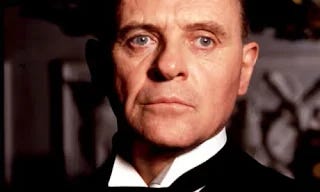
I had established early on that these were English manor house servants: bland, self-effacing, efficient, striving to be invisible. Think Stevens in The Remains of the Day. There simply was no way on earth that these two would lower themselves to a physical altercation, especially in front of their fellow servants, who operate by the same algorithm.
So if I wanted to spice things up for the reader, I was going to have to take an alternate route, on another level. I was going to have pick the lock, to travel inside my character’s heads:
Oh, in Charles’s imagination it played out very differently. Philip had tried to lay hands on him. Charles had tossed him off, giving him a single slap across the face for good measure. He hadn’t put all his strength into it, but the mark would burn for days. But Philip, in a fit of madness, had come at him again. He had to be taught a lesson. Charles had smashed his stupid face with his fists—right, left, left right. Perhaps he had lost his self-control, just a bit. That’s what happened when the red mist came over his eyes. By the time had finished, Philip’s face was like a slab of raw meat. That was an exercise in discipline that he had no choice but to effect.
He was exhausted just thinking of it.
As for Philip? He was more saturnine than sanguinary. His blood was up, yes, but he wasn’t one to indulge in romantic fantasy. His pulse was singing, his breath shallow, but his mind was a clear-running stream. He would not be baited. For a moment, he conjured a world without Charles, without any Charleses, and he found it good.
Not bad for a first approximation. I can work with that.
Every character is a series of choices which define them. Every choice, once made, limits every other choice. Not your choices, their choices. While consistency is not necessarily a human trait, a character cannot live without it. Sure as searing a steak seals in the juices, a character is sealed by the way they react to outside pressure. If you follow the algorithm, the character will be tasty when you slice into them.
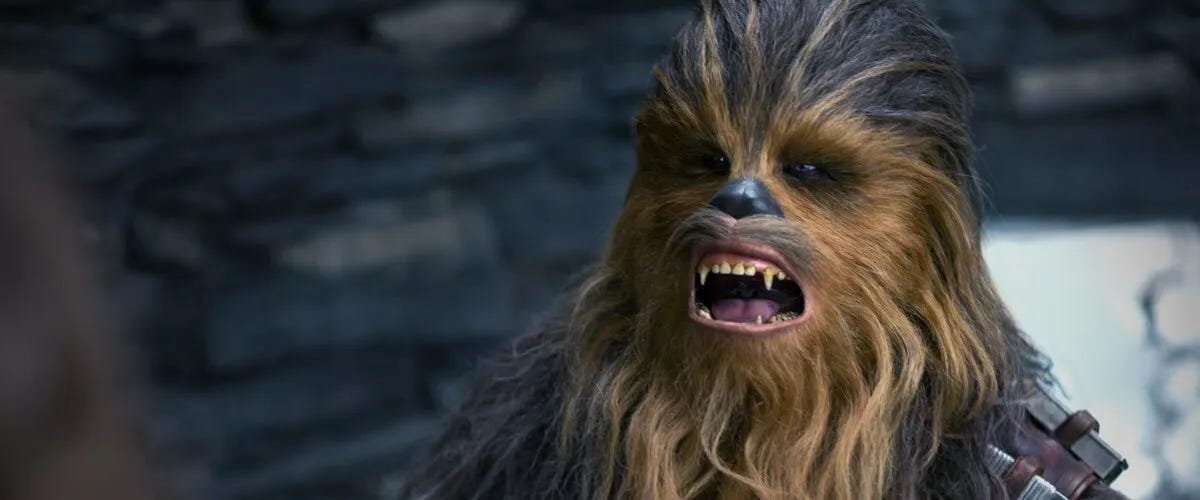
The moral of my story: Let the wookiee win.
This can happen with AI as well as it shifts shape to fill in whatever 'identity vessel' you are presenting with during a given exchange. Also reminds me of my 1998 theory where I postulated family systems are basically a relational database. Which eventually led to the development of a healing pathway for dysfunctional family system survivors suffering from "systemic identity overwrites". All this is my way of saying, "Great post!"
Thanks. I have a character who needs to break up with her lover, but some of my workshop folk think that's too sad. You let me know that too bad, that's what she's going to do. She can't get out of it.